
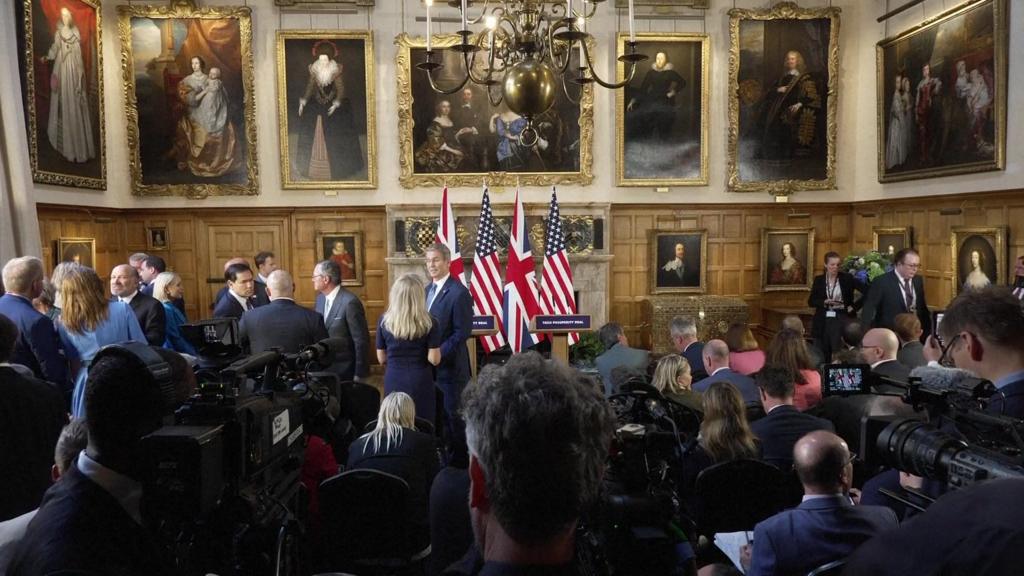

Following a two-day state visit to the United Kingdom, U.S. President Donald Trump and British Prime Minister Keir Starmer held a joint press conference at Chequers, the prime minister’s country retreat.1 The press conference marked the conclusion of a visit that has been dominated by pomp, pageantry, and high-level talks aimed at solidifying the “special relationship” between the two nations.2
Key Themes and Outcomes
The joint appearance followed a series of bilateral meetings and a reception for business leaders.3 Both leaders used the platform to highlight what they framed as a renewed and strengthened partnership.
- Economic Deals: A central focus of the visit was a new “Tech Prosperity Deal.”4 The UK government announced that U.S. companies have pledged over £150 billion in investments in the UK, including major commitments from firms in sectors like AI, quantum computing, and nuclear energy.5 Starmer hailed this as “the biggest investment package of its kind in British history,” and both leaders emphasized the economic benefits for their respective countries.6
- The “Special Relationship”: Starmer and Trump both repeatedly referenced the historical and cultural ties binding the UK and the U.S. Starmer called the relationship “the very foundation of our security, our freedom and our prosperity,” while Trump described the bond as “unbreakable.”7 The rhetoric was notably warm, with Starmer referring to the U.S. president as “my friend, our friend.”8
- Foreign Policy: The leaders’ private discussions reportedly covered complex global issues, including the conflicts in Ukraine and Gaza.9 While the press conference did not reveal a detailed public breakdown of these talks, the joint front was intended to signal a unified approach on the world stage.
- Symbolism and Pageantry: The visit was steeped in symbolism, with Trump receiving a rare second state visit and being hosted at Windsor Castle by the King and Queen.10 Starmer’s government also leaned into the pageantry, welcoming the president at Chequers with a guard of honor and bagpipers, a nod to Trump’s Scottish heritage.11 These gestures were widely seen as a diplomatic effort to build rapport and ensure a smooth visit.
Political Context
The visit was not without its political complexities. Starmer’s government has been keen to demonstrate its ability to manage the relationship with the U.S. under a new administration, particularly as it faces domestic political challenges.12 The visit was viewed as a critical test of Starmer’s statesmanship and his ability to secure tangible benefits for the UK.
For Trump, the visit provided an opportunity to engage with a key ally and showcase his diplomatic standing. He was kept largely away from central London and planned protests, with the itinerary focusing on royal engagements and private meetings at Chequers.13 This strategic scheduling aimed to minimize any public friction and maximize the ceremonial and business aspects of the trip.


